What Business Stewardship Now Requires

Business stewardship is not a softer name for sustainability.

It is a harder question.

It asks whether an organization is protecting the conditions its own future depends upon.

That question reaches beyond environmental performance.

It reaches into strategy, design, governance, value creation, product choices, technology use, leadership behavior, and the assumptions a business treats as normal.

For many years, business sustainability has been asked to reduce harm.

That work matters.

But reducing harm is not the same as creating future capacity.

A business can become less damaging and still remain dependent on systems, materials, incentives, and beliefs that cannot continue indefinitely.

That is why stewardship now matters.

Stewardship Begins Before Strategy

Strategy usually begins with goals.

Stewardship begins earlier.

It asks what the organization believes it is responsible for.

It asks what kind of future the business is helping to create.

It asks what the business depends upon that does not appear on its balance sheet.

It asks what the organization is willing to count, and what it has learned to ignore.

Those questions shape strategy before any plan is written.

If they remain unexamined, the strategy may be well organized and still insufficient.

That is one reason sustainability has reached a ceiling.

The work has often been added to business as a correction.

Stewardship asks whether it belongs inside the definition of business itself.

Circularity Is Not Enough On Its Own

Circularity has given business an important language of flows, materials, reuse, recovery, and design.

It has helped many organizations move beyond the idea that value ends at disposal.

That is valuable.

But circularity without sustainability is not enough.

A system can be circular and still be extractive.

It can keep materials moving while leaving deeper questions untouched.

It can optimize loops without asking whether the loops strengthen life, communities, ecosystems, or future business capacity.

The question is not only:

Can we keep this material in use?

The deeper question is:

What kind of system are we sustaining by keeping it in motion?

That is where sustainable circularity begins.

AI Raises The Stakes

Artificial intelligence now adds another layer.

AI can help leaders think, explore, summarize, compare, draft, and decide.

It can also accelerate the assumptions already inside the organization.

If the organization’s sustainability frame is too narrow, AI may reproduce that narrowness with speed and confidence.

If the organization’s definition of value excludes important consequences, AI may help optimize inside that exclusion.

If the organization already prefers a decision, AI may help make that preference sound more objective.

This does not make AI the enemy.

It makes human judgment more important.

Stewardship now includes responsibility for the questions we ask AI, the assumptions we accept from it, and the decisions we allow it to influence.

The Leadership Shift

The next phase of business stewardship will require leaders to become more attentive to the architecture of their own decisions.

Not only:

What are we doing?

But:

What are we assuming?

Not only:

What can we measure?

But:

What have we made invisible?

Not only:

How do we reduce impact?

But:

What conditions are we responsible for strengthening?

Not only:

How do we use AI?

But:

What should remain accountable to human judgment?

These are not abstract questions.

They affect investment, innovation, disclosure, product design, customer trust, regulatory exposure, leadership credibility, and long-term value creation.

What Comes Next

My recent books approach this from different angles.

Our Common Future-Now asks why sustainability reached a ceiling and what assumptions may be holding it there.

Perfectly Wrong asks how AI can turn those assumptions into faster, more confident business risk.

Real Circularity, co-authored with Rachel S. Kan, explores how circular principles can move from theory into practice.

Together, they point toward the same underlying question:

What does business need to become if it is to create prosperity without undermining the conditions prosperity depends upon?

That is not a slogan.

It is work.

It is the work of stewardship.

And it belongs wherever leaders are making decisions that reach beyond the next reporting cycle.

Calls To Conversation

Explore Ken’s books: BOOKS

Read Our Common Future-Now: OUR COMMON FUTURE-NOW ON AMAZON

Read Perfectly Wrong: PERFECTLY WRONG ON AMAZON

View Real Circularity: REAL CIRCULARITY ON AMAZON

Invite Ken to speak on business stewardship and future capacity: KEYNOTE SPEAKING

Explore Circularity Edge advisory work: CIRCULARITY EDGE
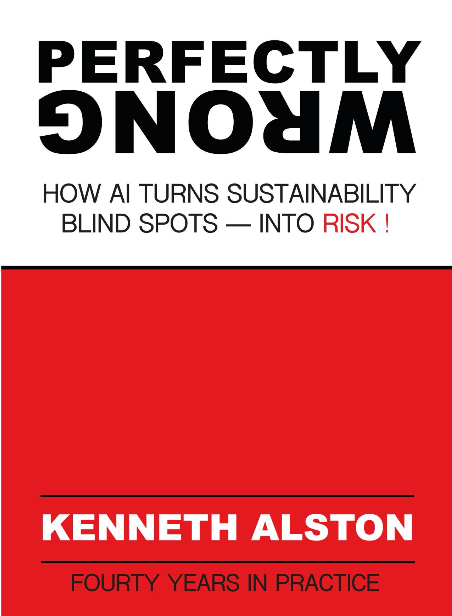
How AI Turns Sustainability Blind Spots Into Business Risk

The greatest risk is not only that AI gets sustainability wrong.

It is that AI may reproduce yesterday’s assumptions with extraordinary speed, fluency, and confidence.

That is the argument behind Perfectly Wrong.

When ChatGPT first became available to the public, I began using it like many people did: with curiosity, skepticism, and a willingness to see what the tool could do.

In 2023, while preparing a keynote for the Adhesive and Sealant Association Sustainability Summit, I began testing how AI systems responded to sustainability questions.

The results were not simply wrong.

That would have been easier.

They were often structurally coherent within a frame that already carried the limitations of the sustainability field itself.

In other words, the answers could be fluent, useful, and reasonable while still resting on assumptions that deserved examination.

That is a different kind of risk.

Perfectly Wrong - AI Risk

Confidence Changes The Risk

Business leaders are used to reviewing imperfect information.

They know a draft may be incomplete.

You know a model may need testing.

And you know a consultant’s recommendation may reflect the assumptions in the brief.

But AI changes the feel of the answer and AI risk management.

It can make an incomplete evidence base appear more complete, old definitions feel settled.

And it can make a narrow question produce a broad recommendation.

It can make a preferred decision sound more objective than it is and it can remove friction that should have remained.

That is not only a technology problem.

It is a judgment problem.

The Blind Spot Beneath The Output

Most conversations about AI risk focus on hallucination.

That matters.

Facts matter.

Sources matter.

Accuracy matters.

But hallucination is not the only risk.

There is also the quieter problem of inherited assumptions.

What does the answer assume about sustainability?

Mean by circularity?

Treat as evidence?

Define as success?

Whose perspective is missing?

What does it make easier to approve?

And what would have to be true for the opposite conclusion to be right?

Those questions are not technical housekeeping.

They are governance questions, strategy and business-risk questions.

Where This Becomes Exposure

AI-supported sustainability work becomes more serious when it begins to influence:

  • executive recommendations
  • board materials
  • ESG or sustainability claims
  • circularity strategies
  • investor communications
  • customer-facing language
  • risk assessments
  • market analysis
  • governance policies
  • public commitments

At that point, the organization is no longer simply exploring an idea.

It may be preparing to rely on an answer.

Before that happens, leaders need to know what the answer is carrying.

Not only the facts.

The assumptions.

The Better Question

The most important question is not:

Did the AI get the answer right?

The more useful question may be:

What assumptions made this answer possible?

That question slows the work down in the right place.

It does not reject AI.

It makes AI more responsible.

It asks human beings to remain accountable for the definitions, boundaries, evidence, and judgment that the tool cannot own on their behalf.

A Practical Starting Point

If your organization is already using AI-supported work in sustainability, strategy, reporting, governance, or board materials, start with one live decision area.

Do not audit everything.

Choose one output that may influence something important.

Then ask four questions:

  1. What decision will this answer influence?
  2. What assumptions had to be true for this answer to make sense?
  3. What has been verified outside the AI output?
  4. What needs human judgment before this moves forward?

If those questions are easy to answer, good.

If they are difficult to answer, the output may not be ready to carry executive weight.

That is why I created the AI Assumption-Risk Checklist.

And it is why I wrote Perfectly Wrong.

Both are attempts to help leaders see the risk before it becomes normal operating practice.

Calls To Conversation

Download the AI Assumption-Risk Checklist: AI CHECKLIST

Read Perfectly Wrong: PERFECTLY WRONG ON AMAZON

Explore Ken’s books: BOOKS

If your organization is already relying on AI-supported recommendations, disclosures, strategy, or board materials, book a diagnostic conversation: [CONTACT OR BOOKING LINK]

Why Sustainability Reached A Ceiling

For almost five decades, I have been asking why business sustainability has produced so much activity and yet so little transformation.

That question is not an accusation.

It is an observation.

Across companies, industries, governments, NGOs, universities, and professional communities, enormous effort has gone into sustainability. People have changed materials, improved processes, redesigned products, reduced waste, measured impacts, reported performance, set targets, and built whole careers around improving the relationship between business and the world it depends upon.

Some of that work has mattered.

Some of it has reduced harm.

Some of it has changed what companies measure, discuss, and claim responsibility for.

And still, the larger trajectory remains deeply concerning.

That is the tension at the heart of Our Common Future-Now.

The easy conclusion would be that sustainability has failed because business did not care enough.

That is too simple.

Many people cared deeply.

Many organizations invested seriously.

Many leaders tried to move the work forward inside real constraints.

The more useful question is different:

What if the ceiling was built into the assumptions we brought to the work?

The Ceiling Was Not Only Technical

For many years, sustainability was treated as a technical problem.

If we had better materials, better data, better metrics, better standards, better technologies, and better disclosure, surely the trajectory would change.

Those things matter.

But they do not, by themselves, change the operating beliefs of a business.

A company can become more efficient while still growing in ways that overwhelm the savings.

It can reduce the impact of a product while selling more products into the same linear system.

It can report more comprehensively while still making decisions inside the same inherited model of value.

It can improve what is measured without changing what is assumed.

That is where the ceiling begins.

Not at the level of tools.

At the level of belief.

The Question Beneath The Work

Sustainability often asks:

How do we reduce the negative impacts of business?

That is an important question.

But it may not be enough.

The deeper question is:

What are we trying to sustain, and for how long?

That question changes the work.

It moves sustainability away from being only a performance improvement agenda and toward a test of business design, decision-making, value creation, and responsibility over time.

If a business improves its sustainability performance while continuing to undermine the conditions its future depends upon, something is still unresolved.

The problem is not that the work is meaningless.

The problem is that the work may be operating inside too narrow a frame.

Why This Matters Now

The sustainability conversation is entering a new phase.

Some organizations are tired.

Some are defensive.

Some are caught between public expectations, regulatory complexity, investor pressure, customer skepticism, and internal fatigue.

At the same time, the planetary and social signals have not become easier to ignore.

This is not the moment to retreat into old language.

It is the moment to ask better questions.

What assumptions are shaping our strategy before the strategy begins?

What does our organization define as success?

What does it treat as external?

What does it optimize for, even when nobody says it out loud?

What forms of progress make the current system more efficient without making it more viable?

Those questions are harder than many sustainability questions.

They are also more useful.

The Work Ahead

If sustainability has reached a ceiling, the answer is not to abandon the work.

The answer is to examine the architecture underneath it.

That means looking at the beliefs, definitions, boundaries, incentives, and decision rules that shape what the organization is able to imagine, approve, and sustain.

It means asking whether the business is designed to reduce harm at the edges, or to create future capacity at the center.

It means recognizing that sustainability is not only a department, a report, a target, or a claim.

It is a test of what the organization believes business is for.

That is the inquiry behind Our Common Future-Now.

The book is now available on Amazon.

It is not a final answer.

It is an invitation to return to the question with more honesty than the moment usually allows.

Calls To Conversation

Read Our Common Future-Now: OUR COMMON FUTURE-NOW

Explore Ken’s books: BOOKS

Invite Ken to speak on why sustainability reached a ceiling: BOOK A CALL

If this question is already present inside your organization, Circularity Edge can help examine where the ceiling may be built into current decisions: CIRCULARITY EDGE

Industry and nature

Dominance, Stewardship, and the Belief Architecture™ for Business

Why Power Makes Responsibility Unavoidable

Over the past few days, the world has been reminded—again—that we do not live in a neutral or gentle system. Power exists. Dominance exists. Force exists. History, geopolitics, and economics all confirm this.

I am not writing about politics here.

I am writing about a pattern—one that shows up wherever power concentrates, whether in governments, corporations, technologies, or species.

That pattern is this:

Where dominance exists, stewardship is no longer optional.


Dominance Is a Fact. Stewardship Is a Choice.

Humans are the dominant species on Earth.
This is not a moral judgment; it is an observable condition.

Our technologies, economies, and institutions now shape ecosystems, climate systems, and the future viability of life itself. Whether we intended this or not is irrelevant. Dominance has already been established.

And dominance carries a consequence that modern systems often try to avoid acknowledging:

The greater the power to shape outcomes, the greater the duty of care for those outcomes.

This principle is not new.
It has been practiced by indigenous cultures, articulated in religious traditions, and explored in philosophy for millennia.

What is new is the scale.


Power Without Stewardship Creates Instability

When dominance is exercised without stewardship, predictable patterns emerge:

  • Short-term wins followed by long-term instability
  • Efficiency gains that erode resilience
  • Growth that undermines its own foundations
  • Control that increases fragility rather than security

We see this in geopolitics.
We see it in markets.
We see it in ecosystems.
And we see it in business.

This is not because leaders are malicious.
It is because dominance is often mistaken for control, and control is mistaken for sustainability.


Business Is One of the Most Dominant Forces on Earth

Modern corporations shape material flows, energy systems, labor conditions, land use, cultural norms, and technological trajectories at a scale unmatched by almost any other human institution.

That reality is precisely why I have spent my working life focused on business.

Business is not peripheral to the sustainability challenge. It is central to it.

More than governments, more than NGOs, and often more than individuals, businesses determine how resources are extracted, transformed, distributed, and returned—or not—to the world. They decide what is made, how it is made, where it is made, and under what conditions.

When aligned with stewardship, business can be one of the most powerful forces for continuity, innovation, and care the world has ever known.

When misaligned, it becomes one of the most efficient mechanisms for degrading the very conditions it depends upon.

My work has always been rooted in this reality: that if we are serious about sustaining life-supporting systems, business is where leverage must be applied, and where responsibility must be consciously assumed.


Sustainability Failed Because It Avoided Power

One of the great failures of modern sustainability practice is that it tried to soften the conversation instead of telling the truth.

It focused on:

  • reporting instead of responsibility
  • metrics instead of meaning
  • incremental improvements instead of structural alignment

Most critically, it avoided confronting dominance.

But dominance does not disappear when ignored.
It simply expresses itself unconsciously.

And unconscious dominance is the most dangerous form.


Stewardship Is Not Restraint. It Is Orientation.

Stewardship does not mean weakness.
It does not mean retreat.
It does not mean abandoning ambition.

It means orienting power toward continuity rather than short-term advantage.

True stewardship asks different questions:

  • What conditions does this system depend on?
  • How might our success undermine those conditions?
  • What must be sustained for this enterprise—and others—to endure?
  • Where are we strong enough that our choices carry irreversible consequences?

These are not ethical questions alone.
They are strategic questions.


The Primal Mandate™

Every living system follows a simple law:

Life must sustain the conditions that allow life to continue.

This is not ideology.
It is biology.

Human systems—including businesses—are now powerful enough that they must consciously align with this law, or they will violate it by default.

This is what I call the Primal Mandate™.

It does not ask whether we should care.
It states that we no longer have the option not to.


A Final Reflection for Leaders

Power reveals character—but more importantly, it reveals design.

If our systems reward dominance without responsibility, they will produce instability regardless of intent.

If our systems embed stewardship into decision-making, dominance can become a force for continuity rather than collapse.

The question for leaders today is not whether they hold power.

It is whether they are willing to own the responsibility that power already implies.

Because power does not make stewardship optional.

It makes it unavoidable.

—Ken Alston
January 6th, 026

These themes are explored further through conversations with business leaders on the Circularity Catalyst Podcast.

This essay sits at the intersection of business leadership, sustainability, stewardship, and long-term enterprise responsibility.