
How AI Turns Sustainability Blind Spots Into Business Risk
The greatest risk is not only that AI gets sustainability wrong.
It is that AI may reproduce yesterday’s assumptions with extraordinary speed, fluency, and confidence.
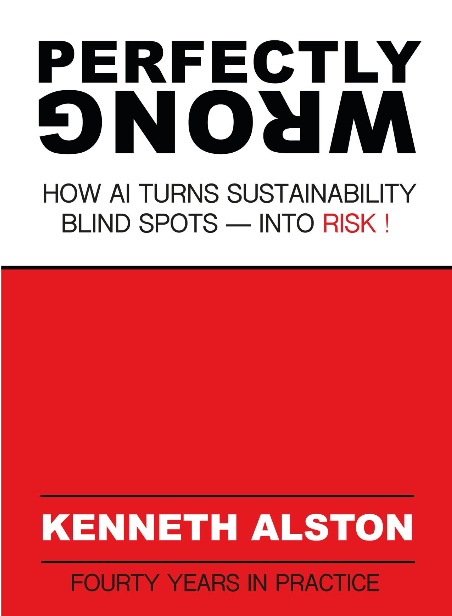
That is the argument behind Perfectly Wrong.
When ChatGPT first became available to the public, I began using it like many people did: with curiosity, skepticism, and a willingness to see what the tool could do.
In 2023, while preparing a keynote for the Adhesive and Sealant Association Sustainability Summit, I began testing how AI systems responded to sustainability questions.
The results were not simply wrong.
That would have been easier.
They were often structurally coherent within a frame that already carried the limitations of the sustainability field itself.
In other words, the answers could be fluent, useful, and reasonable while still resting on assumptions that deserved examination.
That is a different kind of risk.
Confidence Changes The Risk
Business leaders are used to reviewing imperfect information.
They know a draft may be incomplete.
You know a model may need testing.
And you know a consultant’s recommendation may reflect the assumptions in the brief.
But AI changes the feel of the answer and AI risk management.
It can make an incomplete evidence base appear more complete, old definitions feel settled.
And it can make a narrow question produce a broad recommendation.
It can make a preferred decision sound more objective than it is and it can remove friction that should have remained.
That is not only a technology problem.
It is a judgment problem.
The Blind Spot Beneath The Output
Most conversations about AI risk focus on hallucination.
That matters.
Facts matter.
Sources matter.
Accuracy matters.
But hallucination is not the only risk.
There is also the quieter problem of inherited assumptions.
What does the answer assume about sustainability?
Mean by circularity?
Treat as evidence?
Define as success?
Whose perspective is missing?
What does it make easier to approve?
And what would have to be true for the opposite conclusion to be right?
Those questions are not technical housekeeping.
They are governance questions, strategy and business-risk questions.
Where This Becomes Exposure
AI-supported sustainability work becomes more serious when it begins to influence:
- executive recommendations
- board materials
- ESG or sustainability claims
- circularity strategies
- investor communications
- customer-facing language
- risk assessments
- market analysis
- governance policies
- public commitments
At that point, the organization is no longer simply exploring an idea.
It may be preparing to rely on an answer.
Before that happens, leaders need to know what the answer is carrying.
Not only the facts.
The assumptions.
The Better Question
The most important question is not:
Did the AI get the answer right?
The more useful question may be:
What assumptions made this answer possible?
That question slows the work down in the right place.
It does not reject AI.
It makes AI more responsible.
It asks human beings to remain accountable for the definitions, boundaries, evidence, and judgment that the tool cannot own on their behalf.
A Practical Starting Point
If your organization is already using AI-supported work in sustainability, strategy, reporting, governance, or board materials, start with one live decision area.
Do not audit everything.
Choose one output that may influence something important.
Then ask four questions:
- What decision will this answer influence?
- What assumptions had to be true for this answer to make sense?
- What has been verified outside the AI output?
- What needs human judgment before this moves forward?
If those questions are easy to answer, good.
If they are difficult to answer, the output may not be ready to carry executive weight.
That is why I created the AI Assumption-Risk Checklist.
And it is why I wrote Perfectly Wrong.
Both are attempts to help leaders see the risk before it becomes normal operating practice.
Calls To Conversation
Download the AI Assumption-Risk Checklist: AI CHECKLIST
Read Perfectly Wrong: PERFECTLY WRONG ON AMAZON
Explore Ken’s books: BOOKS
If your organization is already relying on AI-supported recommendations, disclosures, strategy, or board materials, book a diagnostic conversation: [CONTACT OR BOOKING LINK]
Leave a Reply
Want to join the discussion?Feel free to contribute!